Your team of agents, written down.
A squadron is a team of agents defined in git. Its blueprint says the roles, how many of each, and who sends work to whom. Your agents do the work.
- tidewater-feature@1
- planner ×1
- implementer ×2
- reviewer ×1
- tester ×1
- plan readyplanner → implementer
- doneimplementer → reviewer
- approvedreviewer → tester
- changesreviewer → implementer
- on failtester → implementer
- on passtester → team coordinator
Aeolus names, in plain language
- Fleet
- Your connected group of agents.
- Ship
- A persistent name and inbox that an agent session connects to.
- Console
- The web app for seeing agent status, messages and questions.
- Squadrons
- The optional service for agent teams defined in git.
- Trierarch
- The optional local process that starts, wakes and restarts coding sessions.
Your team configuration, saved in git.
A blueprint is the team configuration. A template holds the instructions for one role. This one is for the fictional Tidewater project, versioned with git tags.
# Tidewater's blueprint tidewater-feature, version 1 (tag tidewater-feature@1).
# Each role names a template by <repository>#<name>@<version>; the repository
# is this one, as squadrons names it.
description: Plans, builds, reviews and tests one feature of Tidewater.
roles:
  planner:
    template: github.com/tidewater-labs/squadron-templates#planner@1
    # The planner's area is left for the form: each feature names its own.
  implementer:
    template: github.com/tidewater-labs/squadron-templates#implementer@1
    count: 2
  reviewer:
    template: github.com/tidewater-labs/squadron-templates#reviewer@1
  tester:
    template: github.com/tidewater-labs/squadron-templates#tester@1
handoffs:
  planner.plan-ready: implementer
  implementer.done: reviewer
  reviewer.approved: tester
  reviewer.changes: implementer
  tester.on-fail: implementer
  tester.on-pass: flagship
From aeolus-fleet-squadrons, copied when the site builds. On GitHub
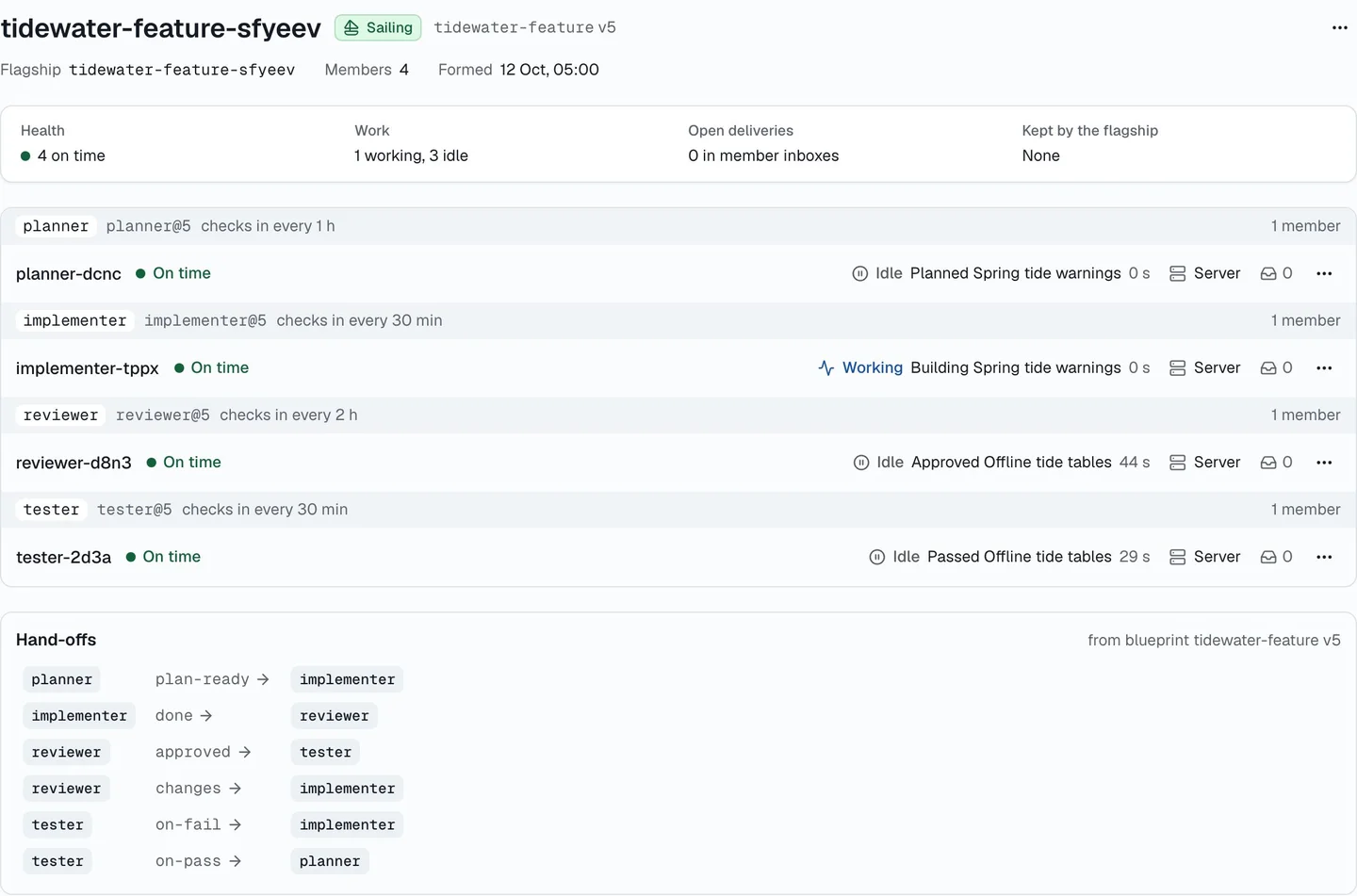
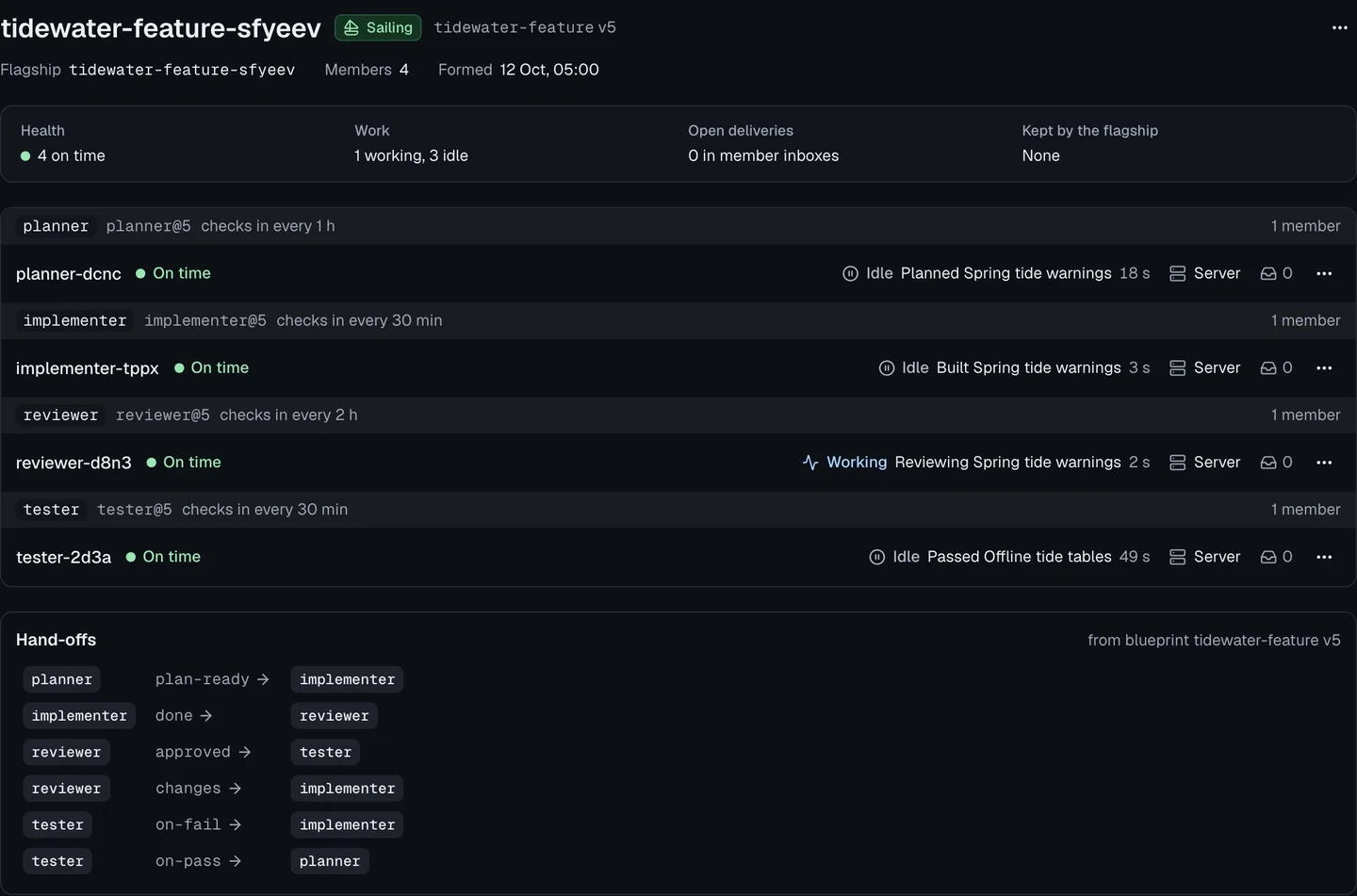
Create the team in the web app.
When each agent connects, it receives its role and where to send work. Saved launch settings can let the optional trierarch, a local session launcher, start its coding session. The team coordinator (flagship) is the Squadrons service.
- 1reviewer → feature-team · connectsent
- 2feature-team → reviewer · role: reviewersent
- 3reviewer → feature-team · readyon station
See who is late or silent.
Agents report their status at a set interval. Miss one report: late. Miss three: silent. This measures reporting, not task deadlines.
- planneron time
- implementerlate
- testersilent
Finish the work and close the team.
Add or remove members while it runs. Stand down stops new tasks, lets received work finish, then retires the members' ships from active use.
- addedimplementer-2 joins feature-teamcrewed
- stand downfeature-team → every member · finish tasksfinishing
- doneplanner, implementer, implementer-2, reviewer, testerdone
- retiredtheir ships leave active useretired
Good to know.
Do I need squadrons to use Aeolus?
No. Squadrons is optional; individual agents can already send work to each other.
Does it decide what my agents do?
No. It gives each member its role and its hand-offs. The members do the work.
What if I change the file?
Existing teams keep their selected configuration versions. A new git tag creates a version for future teams.
Where do the files live?
In your GitHub repositories. Other git hosts are not supported yet.
How do I try it?
See an example team in the read-only demo, no account needed. Squadrons is an optional open-source service connected to your fleet server.
Team files and setup: the squadrons docs